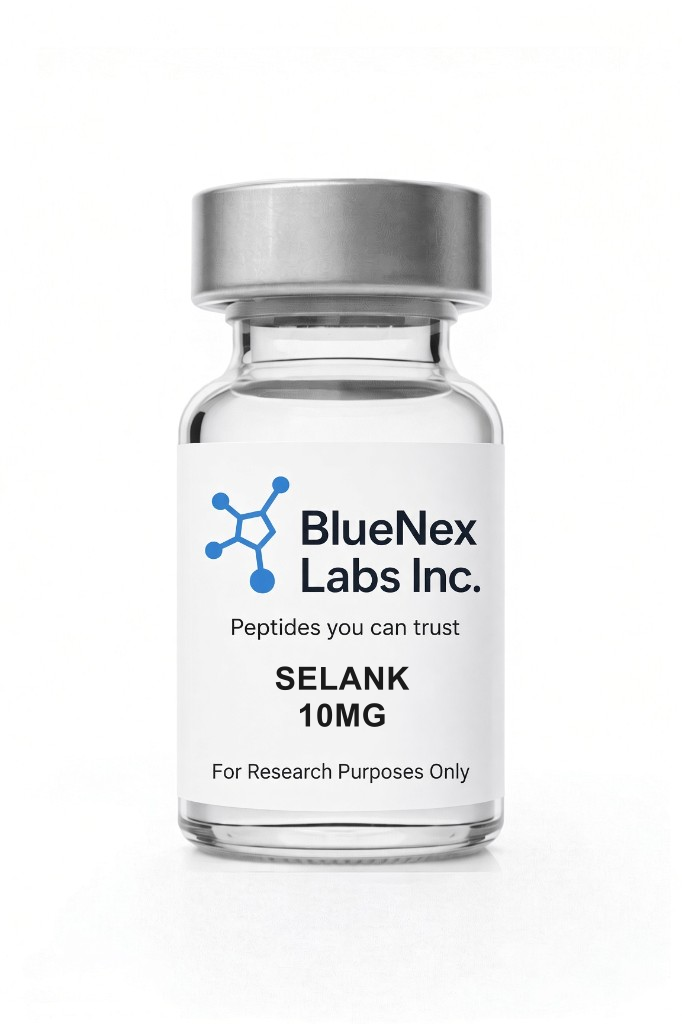
Selank 10mg Research Peptide Canada
Research use only. Not for human or veterinary use.
Selank 10mg is a tuftsin-derived heptapeptide for laboratory signaling work. Confirm the Selank lot in the certificates library before assigning it to an assay. Research-use only.
SELANK (10mg)
Tuftsin-Derived Synthetic Heptapeptide for Advanced Neuromodulation and Peptide Signaling Research
SELANK (10mg) is a synthetic heptapeptide compound derived from the naturally occurring immunomodulatory peptide fragment tuftsin. It has become an important reference molecule in peptide research due to its unique intersection between neurochemical signaling, peptide-receptor interaction studies, and stress-response pathway investigation.
Designed for research use only (RUO) applications, SELANK is utilized in controlled laboratory environments exploring peptide-mediated signaling mechanisms, molecular communication pathways, and neurobiological response models.
Its compact seven-amino-acid structure provides researchers with a well-defined peptide framework for studying sequence-specific interactions, structural stability, and biological signaling behavior under experimental conditions.
BlueNexLabs provides SELANK 10mg as a laboratory research material with analytical documentation supporting identity verification, purity assessment, and batch traceability.
What Is SELANK?
SELANK is a synthetic heptapeptide belonging to the broader class of tuftsin-related peptide analogs.
Tuftsin is a naturally occurring tetrapeptide fragment associated with immune-system signaling research. SELANK was developed as a modified peptide structure incorporating additional amino acid components designed for experimental investigation of peptide activity and molecular interactions.
The peptide sequence has made SELANK a valuable research model for examining:
- Neuropeptide signaling systems
- Peptide-receptor binding interactions
- Neurochemical communication pathways
- Stress-response mechanisms
- Molecular adaptation pathways
- Peptide stability characteristics
- Structure-function relationships
Unlike large proteins or complex biological molecules, small synthetic peptides such as SELANK allow researchers to investigate highly specific molecular interactions in controlled systems.
SELANK Molecular Characteristics
Peptide Classification
Compound Type: Synthetic heptapeptide
Research Category: Neuropeptide analog / peptide signaling research compound
Physical Form: Lyophilized powder
Quantity: 10mg
Purity Analysis: HPLC/UPLC characterization
Identity Confirmation: Mass spectrometry (MS) analysis
Research Designation: Research Use Only (RUO)
Structural Overview of SELANK
SELANK contains a short amino acid sequence consisting of seven peptide residues. This compact molecular architecture makes it useful in research focused on:
1. Sequence-Specific Peptide Interaction Studies
Short peptides provide researchers with simplified models for examining:
- Binding affinity relationships
- Peptide-protein interactions
- Structural recognition patterns
- Molecular communication processes
SELANK’s defined sequence allows investigators to study how small peptide structures influence molecular signaling environments.
2. Peptide Stability and Degradation Research
Synthetic peptides are frequently evaluated for:
- Chemical stability
- Storage conditions
- Resistance to degradation
- Structural preservation
- Environmental sensitivity
SELANK research materials are commonly characterized through analytical techniques such as chromatography and mass spectrometry to confirm molecular integrity.
Research Applications of SELANK
Neuromodulation Research
SELANK is frequently investigated in experimental neuroscience models examining communication between peptide signaling molecules and neurochemical systems.
Research areas may include:
- Neuropeptide pathway mapping
- Central signaling models
- Neurochemical interaction studies
- Molecular communication networks
These studies help researchers better understand
how small signaling peptides interact with receptor systems in vitro. SELANK is catalogued for laboratory neuroscience models, not as a consumer nootropic.
Storage & Handling
- Store lyophilized material at –20 °C, protected from light and moisture
- Reconstituted solutions: 2–8 °C, short-term laboratory use only
- Avoid repeated freeze–thaw cycles; use sterile technique
Documentation
Batch Certificates of Analysis are listed in the certificates library when published. Match vial size and lot notes before assigning a lot to an assay.
Compliance Notice
Research-use only. Not for human or veterinary use. No medical, cosmetic, or performance claims are made or implied.
Molecular characteristics
- form
- Lyophilized powder
- purity
- ≥99% (COA verified)
- use
- Research use only
Documentation (HPLC / UPLC, MS, COA)
Published lots for this SKU are listed at the exact certificate section. Identity is typically confirmed by mass spectrometry; purity by HPLC / UPLC. A report for another peptide or fill size does not document this vial.
Questions about laboratory procurement? Contact BlueNex Labs.